
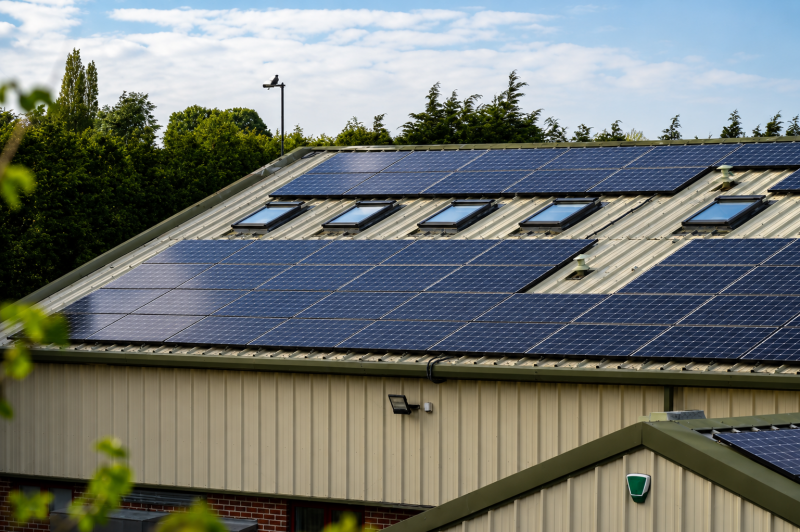
Making commercial roof space work harder
Solar panels are a good fit for many warehouses and factories because these buildings often combine large roof areas with high daytime electricity use. That makes them well suited to generating electricity on site and using it where it is needed most. For businesses with suitable roofs, strong electricity demand and long-term plans for the site, solar panels can turn unused roof space into a practical energy asset.
Why warehouses and factories suit solar panels
Warehouses and factories are often ideal for solar panels because they usually have large, open roofs that can hold a meaningful number of panels. Many also use electricity during the day for lighting, machinery, refrigeration, ventilation, charging, office areas and other operational needs. According to the UK Government’s Solar Roadmap, rooftop solar can help reduce bills and improve energy security by reducing exposure to volatile fossil fuel markets. For warehouses and factories, this matters because electricity is not just a background cost. It is part of daily operations. A well-designed system can help a business use more of the electricity it generates, reduce reliance on imported power and support wider sustainability goals.
The scale of the rooftop solar opportunity
The opportunity for warehouse solar panels in the UK is significant. According to the UK Government’s Solar Roadmap, the largest 20% of UK warehouses alone could provide 75 million square metres of roof space, with an estimated capacity of around 15GW of rooftop solar. The UK Warehousing Association has also reported in written evidence to Parliament that UK warehousing has roof space for up to 15GW of new solar, with the potential to produce up to 13.8TWh of electricity each year. This is why factories and warehouses are now part of the wider solar conversation. The UK Government’s Solar Roadmap also sets out a target to accelerate solar deployment from over 18GW to 45GW to 47GW by 2030.
Reducing grid reliance and supporting business planning
Solar panels for factories and warehouses can help businesses take more control over electricity use. Instead of relying only on grid electricity, a business can generate a share of its power on site during daylight hours. According to Solar Energy UK, commercial and industrial rooftops can reduce grid congestion and minimise transmission losses because they generate power close to where it is used. For businesses, this can support long-term planning. Solar panels can sit alongside battery storage, EV charging, energy monitoring and wider efficiency upgrades, helping warehouses and factories build a more resilient energy setup over time.
Common questions about commercial solar
- Businesses often ask whether their roof is suitable for solar panels. The answer depends on roof size, structure, condition, orientation, shading and electricity use. A proper site survey is needed before any clear recommendation can be made.
- Another common question is whether the business needs to use all the electricity it generates. According to Ofgem’s Smart Export Guarantee guidance, eligible small-scale low-carbon generators can receive payments from electricity suppliers for power exported to the grid, provided they meet the scheme rules.
- A further concern is disruption. For most sites, the key is planning the installation around operations, access, safety and roof condition so the project can be managed clearly from start to finish.
Planning a solar panel system for your site
A commercial solar installation should be designed around the building and the business. A warehouse with high daytime lighting demand may need a different system from a factory with heavy machinery, shift patterns or future EV charging plans. Smart Living Energy’s commercial solar installations guide explains that commercial solar can help businesses reduce overheads, improve energy resilience and support sustainability goals. For businesses in Scotland, a tailored site assessment is especially useful because building type, roof structure, energy use and funding options can vary. The goal is not just to install panels. It is to design a system that works with the site’s energy demand and long-term plans.
Turning unused roof space into long-term value
Commercial solar panels are a practical option for many warehouses and factories because they make use of large roof spaces, support daytime electricity demand and help businesses plan for a more efficient energy future. The UK Government, Solar Energy UK and the UK Warehousing Association all point to the major role commercial rooftops can play in expanding solar power.
Smart Living Energy can assess your site, explain your options clearly and design a commercial solar solution around your building, your electricity use and your business goals.
Please contact us to find out more.
Email – info@smartliving.energy
Telephone – 0800 008 6209
To keep reading, follow on with Smart Living Energy’s guide to commercial solar installations for UK businesses.